For a few years now, I've been giving a version of the same talk. It started life an Auckland Power Platform community event in July 2023 as "Scaling Down: Right-sizing Power Apps implementations for small kiwi businesses," and I've since taken a Spanish-language version of it further afield. The core argument hasn't changed much: small businesses aren't just scaled-down versions of large ones. They're a different kind of thing to build software for. I want to revisit that argument here — partly because it's useful to have it written down somewhere permanent instead of scattered across slide decks, and partly because there's a new layer worth adding. Everything I said about right-sizing Power Apps for small businesses turns out to apply just as well to AI. In some ways, more so.
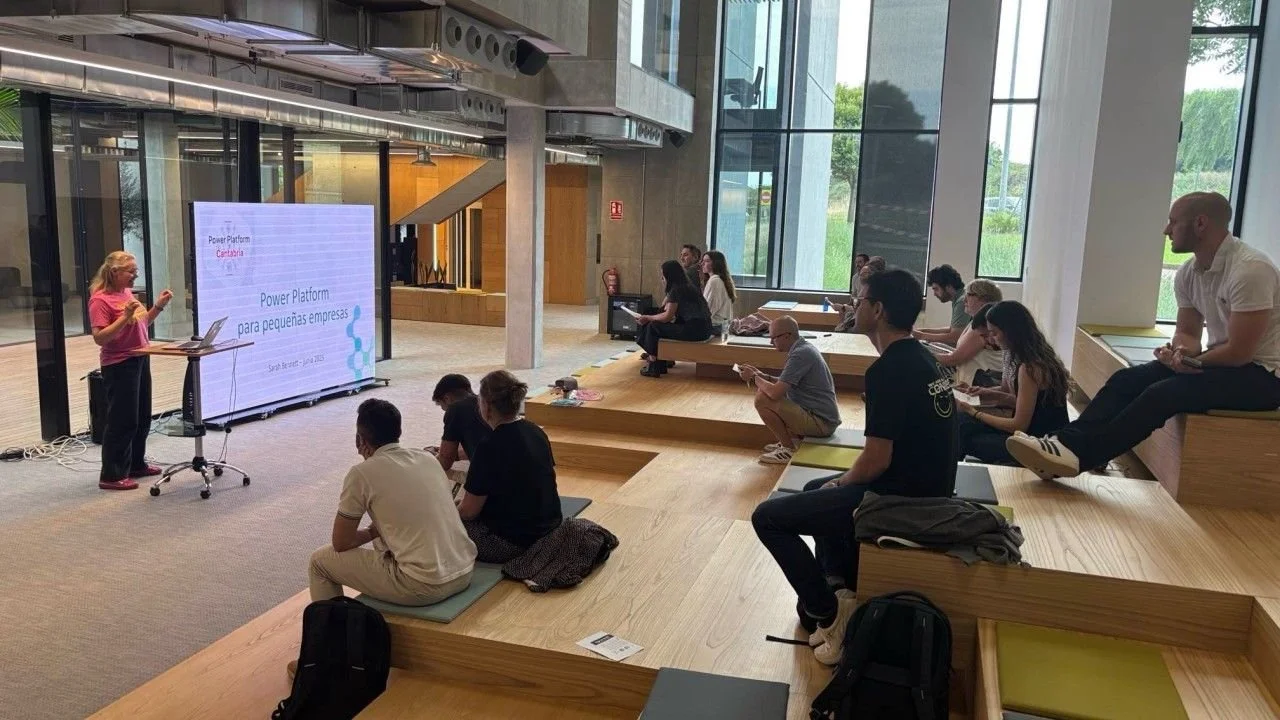
Sarah Bennett presenting “Power Platform para pequeñas empresas” - the Spanish language version of the talk
What even counts as “small”?
One thing that surprises people is how much the definition of "small business" moves depending on who's asking.
MYOB and New Zealand's MBIE both draw the line at under 20 employees
Ireland's threshold is under 50
The UK sits at 10–49
Eurostat's EU-wide definition has micro businesses under 10, small businesses 10–49, and medium businesses 50–249
Microsoft's own definition is generous enough to cover businesses with up to 300 employees
New Zealand is a genuinely unusual case here. We have a much higher proportion of small and micro businesses than most comparable countries, and our "large" enterprises tend to be smaller than their overseas counterparts too. A business that would be considered mid-sized in New Zealand might not even register as a small business by European standards. That gap matters, because many off-the-shelf software — and increasingly, most business AI tooling — is designed with the bigger end of that spectrum in mind.
What's actually different, structurally
Set the employee-count definitions aside for a moment, because the more useful differences aren't about headcount. They're about shape.
There are no layers. Large organisations have management structures with several levels between the person doing the work and the person deciding how the work should be done. Small businesses tend to be flat. The person who owns the problem is often the person who owns the decision.
Corporate functions are a slice of a role, not a department. In a large company, accounting might be twenty people. In a small business, its one person or even a fraction of one person's role. The same goes for IT, HR, and marketing. Nobody's job title is "the IT department," because there isn't one.
There's no internal talent pool to draw from. Small businesses outsource their tech support, so there's no bench of in-house technical experience to fall back on — no colleague down the hall who's solved this exact problem before, no second opinion a few desks away.
Trust arrives much earlier than it does in enterprise work. Before Teal Software, I spent years consulting inside large organisations — a university, a national health provider — where trust built up gradually, through layers of stakeholders, over the life of a programme. There was always a governance function or a security review sitting between a good idea and a green light. With small business owners, that timeline compresses right down. There's no internal IT department for them to lean on instead, so from early in the relationship they're trusting you with decisions that would normally sit behind a procurement process. It changes how carefully you have to listen in those first few conversations, because there's far less of a safety net if you get it wrong.
Decisions happen fast. Without a management hierarchy to route a decision through, the person who can say yes is often in the room. That changes the pace of everything downstream.
The relationship is more direct. I work with end users far more often than I work through layers of project teams and management hierarchy. Often I work with owner's who built their business from nothing, so there's often a different kind of investment in getting it right — it's personal in a way that a line item in someone else's budget isn't.
Nobody's shown them what M365 can actually do. Without the internal IT team translating "what's included in your license" into "what you could be doing with it," that gap just never gets closed. SharePoint is the clearest example — I've encountered many businesses that use it purely as an online file share, with no idea it's also the engine behind lists, libraries, apps and automation. It's not a deliberate choice to keep things simple. It's a knowledge and capability gap.
These traits show up again and again in customers I work with.
Over the years I've come to think of most of my work as falling into a handful of recurring patterns: businesses that can't find an off-the-shelf tool that fits because the available options are built for someone bigger; businesses that have systems covering nearly everything except one gap that needs plugging; businesses whose separate systems need to talk to each other reliably; and — usually the larger clients in this list — businesses extending the useful life of an ageing core system by giving it a mobile front end it was never built with. Different problems, but the same underlying shape: less appetite for the complexity, less headcount to manage it, and a strong preference for something that works over something that's technically impressive.
Updating this for the AI age
None of this was written with AI in mind — the original talks were about right-sizing Power Apps builds. But looking at that list of structural differences again, in 2026, it reads almost like a checklist for why small businesses might actually be better positioned to adopt AI well than large ones are, not worse.
Decisions happen at the speed of one conversation. I haven't worked on AI adoption inside genuinely large organisations — the kind with dedicated governance functions and procurement cycles. But even within my own client base, the difference is obvious the moment a business has any layers at all. Once there's a step (or more) between the person who wants to try something and the person who can approve it, things slow down.
There's less to route around. No IT department means no change advisory process, no security review queue, no competing roadmap to get onto. That's not because small businesses are more sophisticated about AI — it's simply that there's less internal machinery standing between "this is annoying" and "let's fix it."
The feedback loop is short and direct. Because I'm usually working with the actual end user rather than through a chain of business analysts and sponsors, I can build something, put it in front of the person who'll use it, and adjust immediately. That's a much faster and more honest way to figure out whether an AI feature is actually useful, versus theoretically impressive.
The person closest to the problem is often the person who decides. When corporate functions are a slice of one role rather than a department, there's no translation layer between "what the business needs" and "what gets built." The person I'm talking to knows exactly where the tedious, repetitive work is, because they're the one doing it.
The foundations are already flexible. This is the one I feel most strongly about, because it's the throughline of everything I build. A business running on a tailored Dataverse solution has a foundation that's genuinely easy to extend with AI capability — a Copilot Studio agent, an AI Builder model, a smarter flow.
Agility only helps if it's used. This is where I think the real opportunity sits for small kiwi businesses — and also the real risk. Being small and unencumbered is an advantage, but only if it actually gets used. The businesses genuinely well placed here aren't just small. They're small and willing to move.
I don't want to overstate this — small businesses also have real constraints that large ones don't. There's no dedicated innovation team, no slack in the system to absorb a failed experiment, and no in-house expertise to fall back on if something goes wrong.
But the underlying shape of small businesses — flat, fast-moving, directly connected to the people who use the software, built on lean and often surprisingly flexible foundations — is a genuinely good shape for adopting AI well. The same right-sizing thinking that's guided how I build Power Apps solutions for kiwi businesses applies just as directly here. The businesses that get the most value out of AI won't necessarily be the ones with the biggest budgets. They'll be the ones who can move fast, stay close to the actual problem, and build on something flexible enough to grow with them.
We use the AI Contribution Scale defined by Blair Enns to disclose the use of AI in our written content. This article is rated as: AI-4: AI Drafted. The content was drafted by Claude from our own content, we then refined the output.