On Friday I spoke at the New Zealand Business Applications Summit about using Claude Code to build real solutions on the Power Platform. The talk was technical but this article isn't.
A couple of months ago I signed up for Claude because I wanted to compare it to the AI tool I had previously been using for helping with writing code. The experience has helped cement some ideas that had been forming in my head for a while, and which I think apply to anyone using AI tools at work, whatever the tools or the job.
In particular: identifying what you need to keep for yourself, and what to hand over.
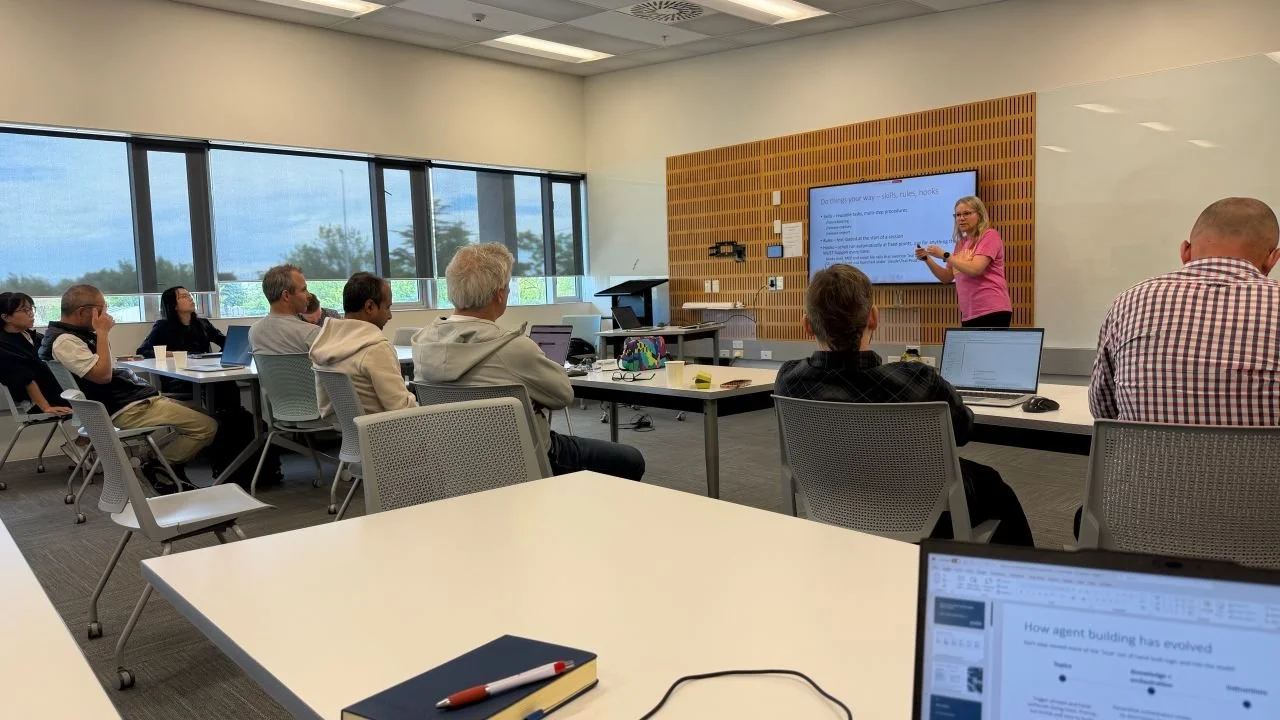
Speaking at NZBAS26, Christchurch 6 November 2026 - photo by Rich Burdes
1. Don't outsource your thinking
I add value through wide experience, both with the technology I work with and with the technology used in different parts of different businesses. My real strength is finding out what a business needs and then translating those needs into software. That includes designing the data structures and the architecture of what gets built, understanding the constraints of the technology, and seeing how data flows through the business.
As part of my experimenting with Claude Code, I tested what happens when I hand that thinking to an AI tool. I wanted to add a new capability to a system I use internally. Rather than design the architecture myself, I handed the task to Claude and bypassed all the deep thinking I normally do when building software.
I ended up with a working solution, but not the mental model that forms when I do that thinking myself. I don't have the in-depth understanding that comes from working out the data structures and the process flow, or from seeing what has to exist before something else can be created. I can't instantly recall the tables, the field names or the flow structure. I haven't formed the mental picture that is a core part of my work.
That's the part I can't hand over. I can use Claude as a thinking partner, for example to help me assess the options available, but the thinking itself has to stay with me. The lesson I took away: don't hand over the deep thinking that forms your understanding, because that understanding becomes the memories and mental models in your own head.
Which parts of your work build understanding that you'd lose if you handed them over?
2. I can learn new concepts much faster
A big benefit for me is how quickly I can get my head around something unfamiliar.
Recently, when I started to create Generative pages (a new capability in Power Apps), I needed to understand what actually gets created behind the scenes when a page is generated by an AI tool. In the past that would have meant reviewing technical documentation, or a long stretch of trial and error. Now I ask Claude while I'm looking at the real thing, and the explanation is about the exact files and code in front of me, not a generic example.
It's the feedback in the moment that makes the difference. I can ask a follow-up question, say "I don't follow that", and get another angle straight away.
How does that apply if you don't write code? Once you've learnt one programming language, and understood functions, loops, if/else statements and libraries, those foundations carry over to any other language. Think of learning to drive: once you can drive one car, you have the foundation for any unfamiliar car. What helps then is someone in the passenger seat who can answer "what does this button do?" or "how do I turn on the windscreen wipers?" That's how AI feels to me when I'm learning something new on top of foundations I already have, its like having someone in the passenger seat who know the specifics of this car.
3. The cost of experimenting has dropped
Building a first version of something now takes a fraction of the time it used to.
A generative page, which is a custom screen inside a power app, takes far less time to put together than building a custom page by hand. That changes what I can offer a customer. Instead of describing a screen and asking them to imagine it, I can often put something real in front of them early and ask: is this on the right track?
Early feedback is cheap to act on, and late feedback is expensive. If the cost of a first draft keeps falling, more of the learning can happen before anyone has committed to a design. That applies well beyond software. A rough version of a report, a process or a form that people can react to is often more useful than a perfect description of one.
4. The bottleneck has moved
Previously, for me, building things was the slow part of the process; there was only so much I could get built in a block of time; so this is where my bottleneck used to be. Now, the bottleneck has moved to checking and validating what gets built by AI.
Those generative pages appear in the blink of an eye, but they still need to be tested and verified. Some of that testing can be automated. The rest needs a person to judge whether the code is well written, whether the screen suits the task someone is actually trying to do, and whether the process behind it makes sense.
The same pattern probably applies in any business. If AI drafts the report, the proposal or the process in a fraction of the time, who reviews it, and do they have the time to do it properly? It's tempting to count the time saved on creating and forget the time now needed for checking. Quality control, review and testing haven't gone away. They've become the main event.
5. AI works at unprecedented speed, but I don't have to
Claude often finishes a task in a fraction of the time it would take me, and then it sits there, waiting for the next one.
It's easy to feel that I should keep up, that an idle assistant means I'm the one holding things up. I’ve had to adjust my tendency to jump in as soon as the response is back. The speed of the tool should not set the determine how long I need to make a decision.
There is still value in sleeping on it. There is still value in stepping away and letting my brain ruminate. My best ideas often arrive when I'm out walking or going for a run, not while I'm staring at a screen. For significant decisions, such as the table structure or the architecture of something we're building, I need to make sure I still give myself that time, because those choices are hard and expensive to change later.
Where in your work does thinking time still need to be factored in, and are you protecting it? Don't let an AI tool that never gets tired dictate the speed at which you make decisions.
6. Just because you can doesn't mean you should
When anything is quick to build, the most important question becomes whether it's worth building.
AI makes it easy to say yes to things. A new screen, a new automation, a new report: each one is now cheap to start. But each one still has to be tested, supported and maintained, and it still takes people's attention. Are we solving the right problems? Or are we solving the ones that happen to be easy now?
A tool that can build almost anything makes the choice of what to build more important, not less.
Where I've landed
I started out wanting to understand which tool to use for coding and ended up cementing ideas that I think apply to anyone using AI tools in their work: make sure you keep the deep thinking that builds understanding, protect the time to sleep on big decisions, and focus on the problems that are worth solving.
We use the AI Contribution Scale defined by Blair Enns to disclose the use of AI in our written content. This article is rated as: AI-4: AI Drafted. The content was drafted by Claude from our own content and ideas, we then refined the output.